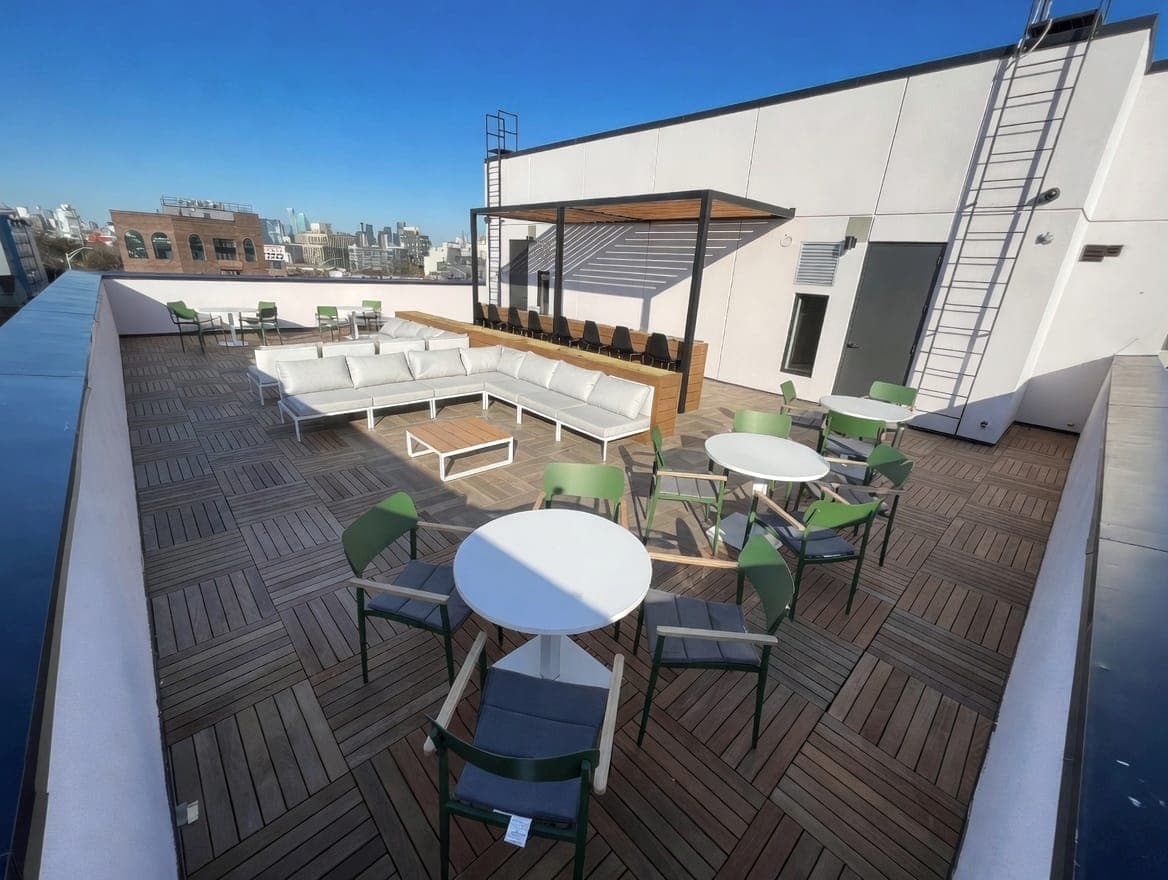
Short answer: yes, almost always. The exceptions are narrow — cosmetic refreshes of existing legal decks, or very small, freestanding additions that don’t touch the building. Most projects worth doing trigger at least one DOB filing. The good news: the process is predictable, the timeline is knowable, and you don’t do any of it yourself.
The four approval layers
Almost every rooftop deck project in NYC touches one or more of these. Most touch all four.
- Your co-op or condo board — alteration agreement, board architect review, sometimes a unit-owner meeting. 6–10 weeks for most buildings.
- Your building’s engineer or architect — sign and seal the structural drawings for DOB filing. 2–4 weeks.
- NYC Department of Buildings (DOB Now) — review and approve the filing. 4–8 weeks for most rooftop work, faster with a clean package.
- Landmarks Preservation Commission (LPC) — only if the work is in a landmark district and visible from a public way. 4–10 weeks when required.
These can run partially in parallel. The board and the engineer can work simultaneously. DOB filing starts once the engineer signs. LPC, when needed, starts in parallel with DOB. A well-coordinated approval path lands in 10–14 weeks total. A poorly coordinated one drags to 6+ months.
When DOB is required
Pretty much always for serious rooftop work. Specifically:
- Any new attached structure (pergola, pavilion, screen wall, planter wall over 4 feet)
- Any structural reinforcement of the existing roof
- Any new gas line for an outdoor kitchen
- Any new electrical circuit (most outdoor lighting and irrigation)
- Any change to fire egress paths (parapet access, fire-rated doors)
- Any change to the building envelope (membrane replacement is usually a separate filing)
When DOB usually isn’t needed
- Replacing existing IPE or paver surface in the same footprint
- Refreshing planters and soft furnishings
- Movable furniture, free-standing planters under a certain weight
- Low-voltage lighting extensions from an existing legal outdoor circuit
The co-op or condo board layer
In most NYC buildings, the board is more demanding than DOB. They want: an alteration agreement signed, your contractor’s insurance certificates naming the building, a schedule that respects building rules (freight elevator windows, no weekend work, no Friday installs), and sign-off from the building’s architect of record.
The board process is 6 to 10 weeks for most buildings. Get the architect of record involved early — they’ll review your structural drawings before they hit the full board, and their changes often save a round of revisions.
The LPC layer (sometimes)
Landmarks Preservation Commission gets involved when both: (1) the building is in a landmark district or is an individual landmark, AND (2) the work is visible from a public way.
A rooftop deck on a 4-story brownstone in a landmark district usually isn’t visible from the street. LPC isn’t involved. But if you’re adding a pergola tall enough to break the roofline, or you’re in a higher-elevation building where the rooftop is visible, LPC review is required. Allow 4 to 10 weeks for review and approval.
The timeline, end-to-end
A realistic NYC rooftop deck approval path looks like this:
- Week 0: design begins
- Week 6: design and structural drawings ready for engineer
- Week 8: engineer signs; alteration agreement to board
- Week 10: DOB filing submitted
- Week 14: board approval
- Week 16: DOB permit issued
- Week 17: construction begins
The whole approval path is typically 12 to 18 weeks. Construction itself follows, usually another 6 to 12 weeks for a full deck. Plan for six to nine months from first call to first dinner on the new deck.
Common questions
- What is DOB and what do they care about?
- The NYC Department of Buildings — the city agency that approves construction work and issues building permits. They care about structural safety, fire code, electrical and plumbing compliance, and zoning. For a rooftop deck, that usually means whether the structure can take the load, whether the deck affects fire egress, and whether anything was attached to the building that needed a filing.
- When can I skip the DOB filing?
- Cosmetic-only refresh of an existing legal deck — replacing IPE boards in the same footprint, refreshing planters, swapping out furniture and lighting that doesn’t involve new electrical circuits — doesn’t typically need a filing. Anything that adds, removes, or modifies structure, or that adds gas/electrical, does.
- What about LPC (Landmarks)?
- Only kicks in if you’re in a landmark district AND the work is visible from a public way. A rooftop deck on a low brownstone in a landmark district usually isn’t visible from the street, so LPC isn’t involved. Anything taller, anything with a pergola or pavilion that breaks the roofline, or anything in a higher landmark zone gets LPC review.
- Can a homeowner file with DOB themselves?
- Technically, for very minor work, sometimes. For 99% of rooftop deck projects, no — the filing requires a P.E. (Professional Engineer) or R.A. (Registered Architect) to sign and seal the drawings. We work with engineers we’ve used many times, or coordinate with the one your building already uses.