Porcelain on pedestals:
modern, modular, accessible.
MintScapes designs and installs porcelain paver patios, walkways, and rooftop decks across NYC, North Jersey, Westchester, and Fairfield County. The cleaner, lower-maintenance answer to natural stone — UV-stable, freeze-safe, and serviceable for life.
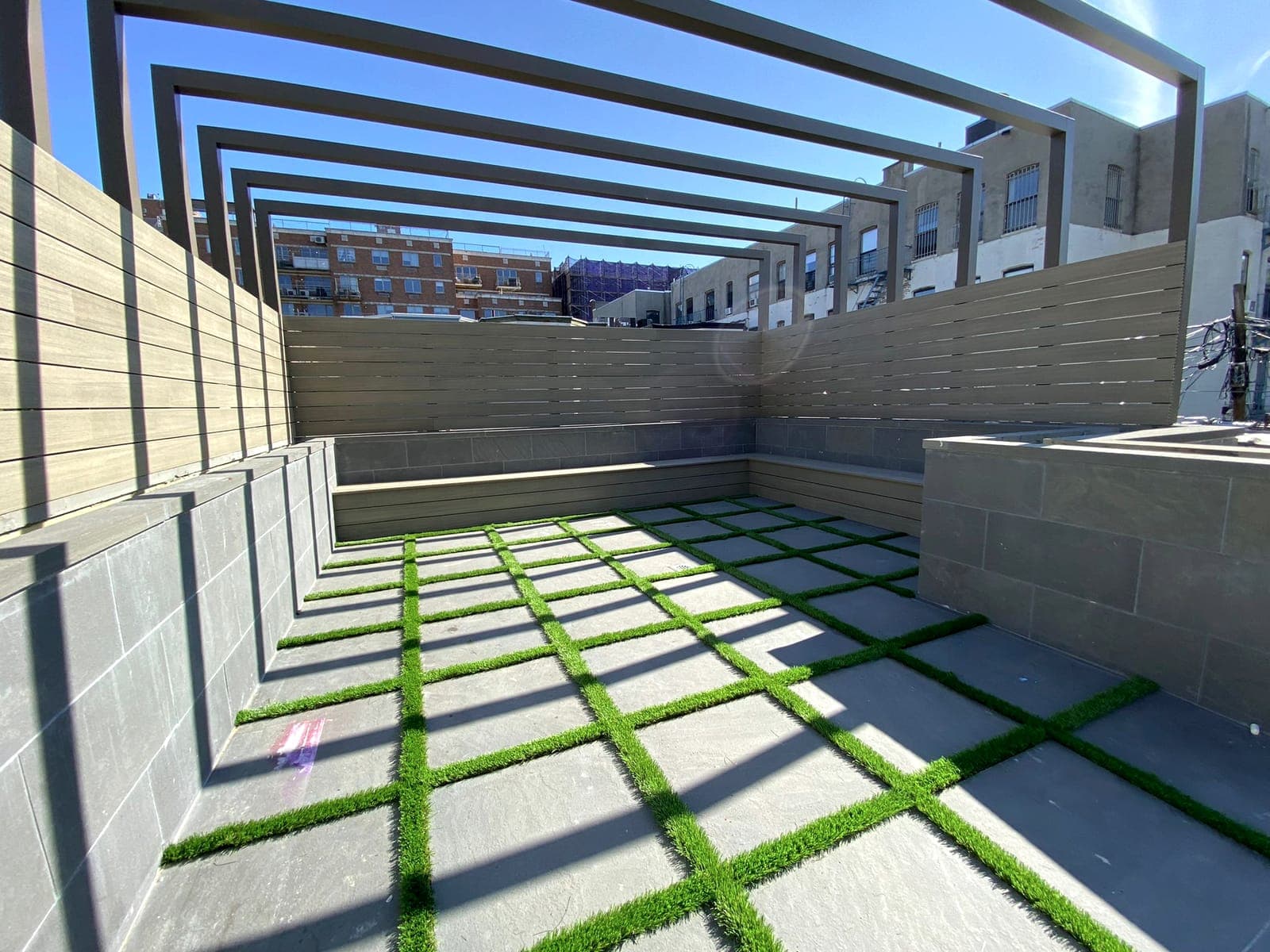
Structural porcelain pavers are a category of outdoor flooring that has matured fast in the last decade. Two-centimeter thickness, kiln-fired to vitrified density, available in formats that mimic stone, concrete, wood, and weathered patina — without the weight, the staining, or the seasonal maintenance. On a NYC rooftop, they’re often the right answer.
We use porcelain pavers most on modern installs and on every rooftop where the membrane needs to stay accessible. The system is modular: each paver sits on adjustable pedestals, lifted clear of the substrate, level to a wire-tight grid. Any paver can be removed in 30 seconds for membrane inspection or replacement. It’s the system serious building owners specify.
Pedestal or mortar — depending on where it sits.
Pedestal system (rooftops, raised terraces)
Adjustable plastic feet (Buzon, Eterno, Versijack) sit on the roof membrane and hold each paver level. Open joints let water drain to the membrane below. Every paver is serviceable. Standard system for any rooftop install — preserves membrane warranty.
Mortar-set (backyards, ground-level patios)
Pavers set on a thinset mortar bed over a compacted stone base. Sand-swept or polymeric-grout joints. The traditional install for a backyard or pool surround. Lower cost, not serviceable as a system — but unnecessary if the ground isn’t moving.
Spec the paver, then spec the system.
2cm structural porcelain, always.The thinner 9–12mm porcelain tiles you see at tile showrooms are interior products. They’ll fail outdoors. Our spec is 2cm minimum for any walking surface — usually 24×24 or 24×48 inch formats.
Slip rating matters. We spec R11 slip-resistant tiles for any walking surface, R13 for pool surrounds and rooftops near drains. The smooth, polished outdoor look is a falling hazard.
Color stays true.Unlike concrete or natural stone, porcelain doesn’t fade in UV. The grey you choose in year one is the grey you have in year twenty. This matters when you’re selecting next to a building facade you can’t change.
Edge detail is design work. Pavers want a clean termination — against the wall, at the parapet, around the drain. We detail every edge in the design phase, not the field.
What clients ask first.
- How much do porcelain pavers cost installed?
- Material is roughly $9–$22 per square foot for 2cm structural porcelain. Installed cost runs $35–$55 per square foot on a rooftop pedestal system, $22–$40 per square foot in a backyard set on a mortar base. The rooftop premium covers the pedestals and the membrane-protection detailing.
- Porcelain or natural stone (bluestone)?
- Both are right, in different places. Bluestone reads classic, weathers softly, develops patina — the right call for traditional brownstones. Porcelain reads clean and modern, doesn’t stain, stays color-true for decades — the right call for modern yards and most rooftops. Porcelain also wins on rooftops because of weight and serviceability.
- What’s the pedestal system?
- Adjustable plastic feet that sit on the existing roof membrane and hold each paver level. They lift the whole deck off the membrane (preserving warranty), allow drainage underneath, and let any paver be lifted later for inspection or repair. It’s the standard system for serious rooftop installs.
- Will porcelain pavers crack?
- 2cm structural porcelain is rated for residential foot traffic on pedestals and for vehicular loads on a mortar base. It can chip on edges if hit hard with metal, but it doesn’t crack in normal use. We use 2cm minimum on every install; thinner tiles are not structural.
- Are porcelain pavers slippery when wet?
- Quality outdoor porcelain has a textured surface that meets ADA R11 slip resistance. We spec slip-rated tiles for every outdoor install. Pool surrounds and rooftops near drains get higher slip ratings still.
- Can porcelain pavers go over an existing patio?
- Sometimes. If the existing base is structurally sound, level, and drains properly, we can lay new porcelain on top — saves the demolition. If any of those conditions fail, the install fails. We’ll tell you on the walk-through.